
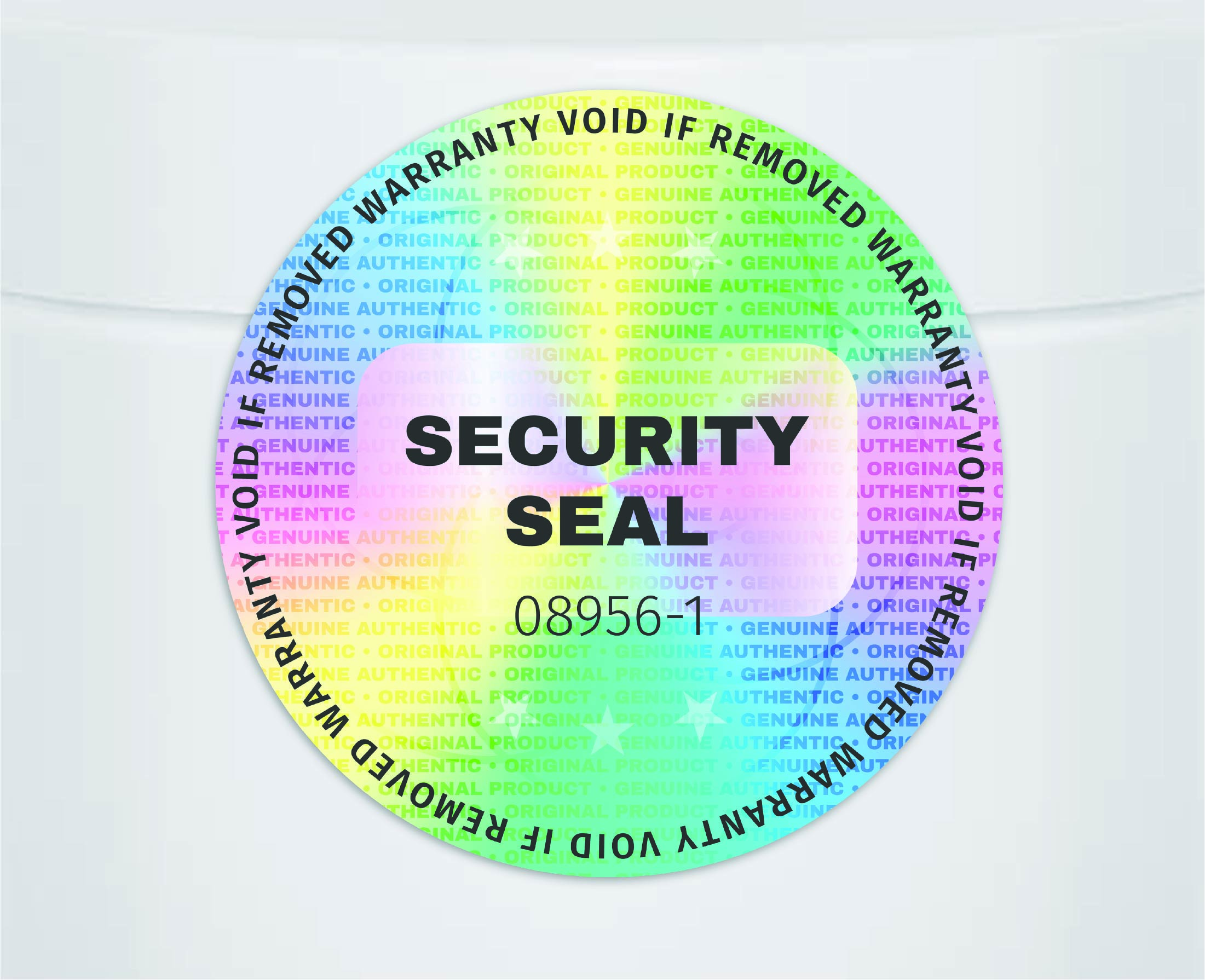
Hero

Custom Tamper-Evident Security Labels

A starter guide to custom tamper-evident security labels 

Trust in your product is everything. Whether you’re a medical supplier, manufacturer or pharmacist, you need confidence that your products arrive exactly as they should. Protecting product integrity is about safety, not to mention preserving trust in your brand.

In today’s complex supply chains, tamper-evident security labels provide visible assurance that products haven’t been opened or altered. 

When it comes to applications like pharmaceutical packaging, these safety labels help safeguard your brand against the costly fallout of unauthorized access, contamination or counterfeiting. They’re also used on equipment for warranty protection and regulatory compliance, helping protect both the brand’s liability and the end user’s safety.

Ultimately, these labels reassure the end user of a product’s integrity and authenticity, confirming that no unauthorized users have interfered with the product during transit or handling.

Applications for tamper-evident labels 

Tamper-evident labels are used anywhere product integrity and chain of custody matter most, including:

  • Pharmaceutical packaging
  • Medical devices (get our guide on durable medical labels
  • Food and beverage containers
  • Electronics and electronics packaging
  • Document sealing and secure transport
  • Recreational vehicles 
  • Equipment 

When you can’t monitor your product 24/7, tamper-evident security labels offer peace of mind. These labels are designed to leave behind clear, visual evidence if someone attempts to open or remove them.

Conversely, when your product or package arrives intact, it reassures both the sender and receiver that the contents inside are safe and unaltered. That’s especially critical in high-stakes industries like medical and pharmaceutical.

Tamper evident labels are also widely used on equipment, enclosures and devices. These labels help companies verify whether sensitive components have been opened, accessed or altered by an unauthorized party. If the seal is broken, it provides immediate visual proof of interference and can void the warranty since unapproved repairs or tampering compromise both performance and safety.

How do tamper-evident security labels work? 

Two common mechanisms make this possible:

Residue labels

When a residue label is lifted or removed, it leaves behind a visible pattern, such as “VOID” or a checker design, on the surface or liner. The label’s face material is engineered with a network of micro die cuts that make it impossible to peel away in one piece. The result is an unmistakable message to the end user: the product has been opened or tampered with.

  • Best for: Single-use applications such as shipping containers, consumer packaging and document security.

Tamper-evident security labels by 3MTM: Residue labels 

Product MaterialAdhesive Properties 
3M™ Tamper-Evident LabelMaterial 7381White PET 300Leaves white VOID message when removed. Compact for small labels.UL/CSA recognized 
3M™ Tamper-Evident LabelMaterial FMV22White PET P1410Leaves white VOID message when removed. Printable top coat. FDA compliant for indirect food contact. 
3M™ Tamper-Evident LabelMaterial FMV02Silver PET P1410Leaves silver VOID message when removed. Well suited for kiss-cutting and automated label production.Printable topcoat. FDA compliant for indirect food contact. 
3M™ Tamper-Evident LabelMaterial 7380Polyester 300 Matte white VOID message when removed. 
3M™ Tamper-Evident LabelMaterialFMV01402White PET P1410 Leaves white triangle pattern when removed. Well suited for kiss-cutting and automated label production. FDA compliant for indirect food contact. 
3M™ Tamper-Evident LabelMaterialFMV01202Silver PET P1410 Leaves silver triangle pattern when removed. Well suited for kiss-cutting and automated label production. FDA compliant for indirect food contact. 

Destructable labels

Made from fragile materials such as vinyl, acetate or paper, these labels are designed to fracture or tear upon removal. They cannot be peeled and reapplied without visible damage, giving the end user immediate evidence of use or interference.

  • Best for: Sealing medicine bottles, medical equipment casings and other high-security packaging. 
  • Note: Not ideal for applications requiring clean removal; fragments can be difficult to remove completely.

Tamper-evident security labels by 3MTM: Destructable labels 

Product Material Adhesive Properties 
3M™ Security Products Label Material 7613T White vinyl 350Bonds to textured and contoured surfaces, powder coatings and slightly oily metals. UL/CSA recognized 
3M™ Performance Label Material 7110 White paper 320 Writeable and printable. Withstands autoclaving, resists flagging on vials and containers. 

Find more 3MTM tamper-evident products

Custom options for tamper-evident security labels 

At iD Products, we deliver peace of mind through tamper-evident solutions customized for your unique application. As a full-service converter and printing provider, we help you identify safely solutions that protect your end users and your brand.  

  • Sourcing: Our preferred partnership with 3MTM ensures access to high-performance materials and adhesives designed for security and durability.
  • Sizing: Precision die cutting, including kiss cutting, for exact dimensions that fit your packaging and application.
  • Printing: Custom colors, logos and serial numbering to align your security labels with your brand and tracking systems.

Need custom tamper-evident security labels? 

From material selection to custom converting and printer integration, iD Products provides complete solutions to secure your products, protect the end user and safeguard your brand. 

Contact our printing and converting experts today and get a quote for your tamper-evident security label needs. 
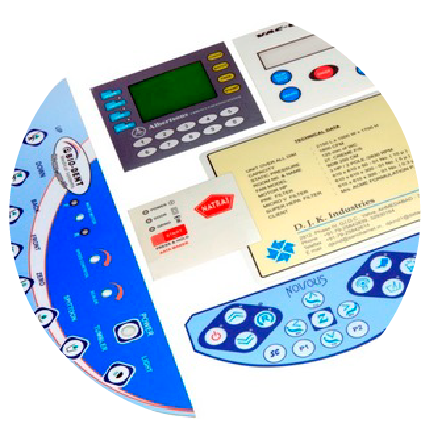
Hero

Choosing the Right Graphic Overlay Manufacturer: What OEMs Need to Know

Choosing the right graphic overlay manufacturer: What OEMs need to know 

Your graphic overlay sets the stage for your product’s success. Whether you make dishwashers, medical devices or industrial equipment, every interaction the end user has happens in this space. The graphic overlay manufacturer you choose matters. A poorly designed and executed overlay can lead to usability problems that linger for years, eroding your brand’s reputation and future sales.

To help OEMs make sound sourcing decisions, we’ve prepared a guide to finding a high quality graphic overlay manufacturer, along with key questions you should ask as you evaluate potential partners.

Why does your choice of graphic overlay manufacturer matter?

Anyone who loves design embraces the unique challenge of creating a graphic overlay. It conveys branding, as well as sets the tone for the user experience. In essence, you’re creating an environment which means the design, look and feel are very much essential here. 

You’ll want intuitive controls with a logical hierarchy and workflow, coupled with sharp print and design with precise color matching. Every one of these elements influence usability. At the same time, overlays must withstand years of use and environmental stress without fading, cracking or peeling.

The task calls for the custom graphic overlay manufacturer that delivers on all points so the end user gets what they are looking for. 

Precision printing and color consistency

First and foremost, you need a manufacturer that has mastered the art and science of printing. Smooth gradients, halftone printing and exact registration are essential to creating overlays that reflect your brand story vividly and with a high degree of accuracy. 

Precision printing and color consistency will define how every overlay looks as it comes off the production line. Consistency from end to end, with no perceptible differences between units, is the standard you should expect.

Questions to ask your manufacturer:

  • Do you use spectrophotometer color matching for brand accuracy?
  • What printing technologies and capabilities do you offer?
  • Can you provide design or prepress support to help align graphics with brand requirements?

Material expertise and options

Every operating environment places different demands on a graphic overlay. A control panel in a heavy manufacturing facility calls for the most rugged materials that endure under constant use and exposure to harsh conditions. For recreational vehicles, a weather-resistant design is a top concern.

A strong graphic overlay manufacturer will offer the inventory, deep supplier relationships and support to build a unit designed to work with your product. A durable overlay starts with the right base material — typically polycarbonate or polyester — as the structural foundation. On top of that, protective films and finishes provide additional durability, clarity or resistance to abrasion and chemicals. For the final layer, a thin pressure sensitive adhesive locks it in place while sealing out dust and moisture. 

Questions to ask your manufacturer:

  • What base materials do you recommend for my application? 
  • What protective films or finishes are available to extend durability?
  • Do you maintain preferred partnerships with suppliers?
  • Can you provide material selection guidance and rapid prototyping for testing?

Precise cutting and finishing capabilities 

Components need the right machining method to minimize material waste and avoid rework, which is why it’s important to work with a converter equipped for just about any job.

Steel rule die-cutting is standard in many applications, but depending on material properties, production volumes, and the level of precision required, methods such as laser or digital cutting may be better suited. The objective is always the same: achieve high quality with minimal waste on the first pass.

A specialized graphic overlay manufacturer or converter has the experienced technicians and advanced equipment to deliver clean, consistent parts with far less waste. 

Because overlays must often align precisely with an underlying control area, die-cutting and CNC routing are essential to consistent output. Features like close-tolerance registration helps you achieve precision in every unit. Advanced processes like these ensure your overlay arrives ready to assemble exactly as designed.

Scrap removal is another overlooked factor in production. A manufacturer that can perform 100% scrap removal from the unit eliminates steps and makes your production line more efficient. 

Questions to ask your manufacturer:

  • What equipment do you use for die cutting and embossing?
  • How do you maintain close-tolerance registration for overlays?
  • What processes or standards do you use for continuous improvement?
  • Do you guarantee complete scrap removal?

Compliance and reliability 

Another less obvious benefit of working with a high-quality converter is that they become an extension of your supply chain. With RoHS compliance in their materials and processes, you’ll establish a clean and transparent chain of custody. 

When the time comes to scale and expand, this compliance can help open access to global markets. RoHS-certified converters can also provide the traceability and compliance statements you need to satisfy auditors and reassure your customers. Beyond regulatory benefits, RoHS speaks to a converter’s ability to maintain strict quality and safety standards, which reflects on your brand and opens access to wider markets? 

Questions to ask your manufacturer:

  • Can you provide RoHS compliance documentation and traceability reports?
  • How do you ensure materials and adhesives remain compliant through production?
  • What quality assurance processes are in place to prevent contamination?
  • How does your compliance program support OEMs seeking global market access?

Looking for a graphic manufacturer? 

Graphic overlays are not just for looks. They can define the entire product experience. Choosing the right graphic overlay manufacturer means finding a partner that’s equipped to create overlays that perform for the life of your product. This requires a high level of printing expertise, material knowledge, cutting precision and compliance standards.

If you’re ready to work with a trusted partner who understands both the design and functional demands of overlays, contact an expert at iD Products.